I have always been interested in the expression of religious themes in film. Catholic guilt of The Godfather trilogy, Constantine’s depictions of Hell, and even the iconography of The Matrix trilogy were all subjects that fascinated me.
It was natural as a young Latter-Day saint with a passion for film that I would be excited by the discovery of “Mormon Cinema”. An entire genre based on one rather specific branch of Christianity?
The Church of Jesus Christ of Latter-Day Saints has produced a great deal in its history; educational, spiritual and promotional films are frequently released. But that was no different to any religion. What interested me was the commercial venture of LDS films, usually made by members of the church seeking to entertain and earn a living.
The creation of Modern LDS Cinema is usually credited to Richard Dutcher who produced the Indie film “God’s Army”. Made on a budget of $300,000 and grossing about nine times that in its theatrical release. It’s a much more thoughtful film than The Best Two Years; it deals with dramatic issues such as death and loss of faith, characters are more nuanced and stakes overall are higher. The film has little marketable value to anyone not familiar with the concept of an LDS Mission, but it avoided the rose tinted goggles of most Christian films.
The financial success of God’s Army did not go unnoticed. It was a simple formulae. a film marketed as “Mormon” would appeal to hundreds of thousands (even millions) of viewers both in and out of Utah. A profit could be automatic provided the film’s budget was relatively low.
“The Other Side of Heaven” a film that inexplicable stars Anne Hathaway successfully mass marketed itself achieving a higher box office of almost $5,000,000. The $7,000,000 budget would imply that it wasn’t very successful, but it boasted a higher production value than previous renditions of the genre.
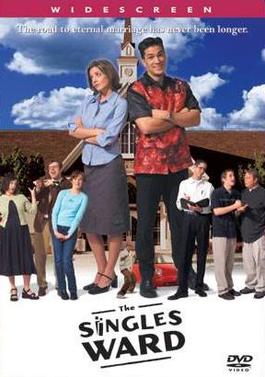
Halestorm Entertainment perfected the financial model with their debut film “The Singles Ward”. Based on the life of John Moyer as a divorced Latter-Day Saint in an LDS YSA Ward. Created on a budget of $500,000 and full of cameos and inside jokes; The Singles Ward more than doubled its budget and lead to a franchise of LDS themed comedies, rarely carrying a religious message but offering light entertainment and relatable comedy to an LDS audience.
“The Best Two Years” was a comedy about Mormon Missionaries appealed to teenage members of the church thinking about serving a mission themselves and usually seeing missionaries a few times a week. My introduction to the genre, it’s a fairly formulaic whacky comedy. The bored and lazy missionary is partnered with a new and enthusiastic missionary. There’s some drama, lots of jokes and in the end everyone is happy. We all loved it.
Films like ”Legacy” and “17 Miracles”would serve as historical dramas. The author Chris Heimerdinger even tried its hand at science fiction in “Passage to Zarahemla”.
The early 2000’s were a busy period for LDS filmmakers; There were over 4,000 entries of film or television shows in the Mormon Literature and Creative Arts Database by 2009.
Alas, despite financial success the LDS Films were not always critically well received, or even particularly good. A friend of mine once commented that most LDS comedies aren’t that funny, its just enjoyable to be part of an inside joke.
I generally enjoyed LDS films, but some of them were absurd. “The R.M” for example was an unwatchable nightmare of generic comedy tropes littered with LDS references and “The Home Teachers” proved to be Halestorm entertainment’s first box office flop. It soon became apparent that despite initial successes LDS Cinema was not the cash cow that many believed it to be.
Richard Dutcher followed God’s Army up with Brigham City, a murder mystery based in a largely LDS town (and my favourite of the genre). It explores issues of faith, trust, family and friendship up against malevolent, evil forces. Despite significant success with critics it slimly failed to make back its budget. Later on “States of Grace” would flop on a far larger scale, earning only a quarter of its budget.
Dutcher would go on to criticize the saturation of the industry with cheap comedies and overly polite faith films; Going on to say
“At the beginning, I was proud to say, ‘Yeah, I’m a Mormon filmmaker’ because then, I was defining what a Mormon filmmaker was. It quickly got completely out of my control. Now, no one wants to call themselves a Mormon filmmaker because you’re associating yourself with a genre that’s fallen into disrepute. It’s like having porn on your resume”.
The overall opinion of LDS films wasn’t bad as such, they generally avoided the criticisms that Pureflix style Christian movies faced because most of them managed to be more than a hollow vessel for preaching. In many ways the obscurity of the industry meant that the lesser projects avoided scrutiny, while the good ones were praised for shining their way out of such obscurity. At worst they’ve simply been regarded as light hearted entertainment and not much more.
There was no crash and burn moment for LDS films. They just slowly faded away as Box Office returns did. They had produced some good films like Brigham City, The Saratov Approach and Sons of Provo, but they had also produced a lot of mediocre ones. I expect most people just felt like there were better films to watch on a Sunday afternoon and the filmmakers found new kinds of projects.
There was something of a comeback though!
The actor Jim Bennett wrote in 2014 his views about LDS Cinema. Saying “I think the hunger is still there but the novelty has worn off. At first, it was enough just to be a Mormon movie. But now, the movie has to actually be good. The audience will reward quality, but it will take better material to get them interested”.
It seems that he was listened to.
Blair Treu’s documentary “Meet the Mormons” was incredibly successful, the theatrical release of which raised over $6,000,000 for the American Red Cross in 2014.
Garett Batty has been very busy in the last decade directing “The Saratov Approach” in 2013, “Freetown” in 2015 and “Out of Liberty” in 2019. All of which brought to life some more exciting chapters of LDS History.
Don Argott won the GLAAD Media Award for his 2018 documentary “Believer”.
So it appears that LDS Cinema might be here to stay, so long as talented filmmakers choose to explore the vast theology and the many facets that follow it.
References:
https://www.deseret.com/2014/4/25/20540085/what-happened-to-the-wave-of-mormon-movies
https://www.imdb.com/name/nm0244756/bio?ref_=nm_dyk_qt_sm#quotes
https://meetthemormons.com/#/filter-all/page-1
https://www.imdb.com/title/tt7689424/
https://mormonarts.lib.byu.edu/
https://www.imdb.com/title/tt0377071/
 T H E N A I V E F I L M M A K E R
Well done
LikeLike