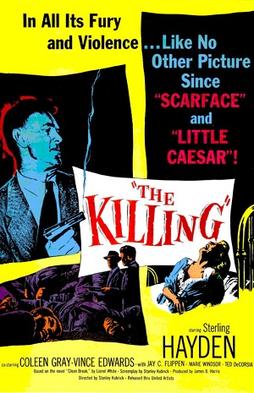
When one thinks of Stanley Kubrick a lot of films may come to one’s mind. Some will think first of A Clockwork Orange, others will think of Dr Strangelove, or in my case it’s The Shining. I know one person who’s first thought is Barry Lyndon, why? I’m not too sure but we like what we like.
So when I was informed that Kubrick made a heist film in 1956 I was slightly taken back to say the least. Never one to make generic popcorn flicks I wasn’t too sure what would interest the man in a film that would share genres with audience films like Going in Style or Tower Block (Both great films in their own right but not an example of Kubrickian filmmaking by any stretch of the imagination).
Nonetheless The Killing not only happened, but is now possibly my favourite of Kubrick’s filmography.
The film follows a group of individuals, a word I choose because there is very little work involving a “Team” or a “Crew” as is often the case in such films. The narrative is more that of a series of individuals playing a small part in what turns out to be a heist. There is almost never any teamwork exhibited and only a few minutes of screen time in which conspirators plan anything together.
The film doesn’t benefit from any modern special effects, explosions or similar benefits of modern filmmaking, but stands out as one of the best of the genre, going on to inspire directors like Quentin Tarantino and Christopher Nolan.
To a large extent the success of the film is divided into two parts. The build-up and the stakes.
The build-up
The Build-up is at surface straight forward. While many heist films include long montages of planning, The Killing is straight to the point, taking place mere days before the heist, the planning is done and the audience is already in a boat with the criminals waiting for the big day to come, approaching it with a great deal of dread. As a result it hits far closer when something is perceived to be going wrong. Whether its George’s growing anger and despondency or a sharpshooter trying to send away a security guard who is just being a nice person.
The narrator’s continual counting down of the clock is a reminder to the audience of the closer and closer arrival of all the things that desperately need to go without a hitch while all the evidence suggests that things are not going to go well.
The Stakes
Far more important in my opinion are the stakes at which the success of the heist depends on, while likeable characters are now part and parcel of heist films. Screen morality was usually more black and white in the fifties as the overzealous censors usually preferred criminals not be shown in a relatable light to its audiences.
Alas, such logic isn’t always in keeping with good filmmaking. Kubrick successfully gives the audience a reason to route for the career criminals. We are introduced to characters who have stories and motivations, for example is a down trodden husband looking to gain back his self-respect, a policeman drowning in debts, an older man who needs the money to properly care for his wife and Johnny who needs the money to elope with Fay and leave behind his life of crime.
While all the men are in the wrong for their actions, its easy to relate to their situations and whether subconsciously or not you route for them and want them to succeed. The final scene before the heist begins is an older conspirator telling another conspirator that he views him as a son, its borderline heart-warming.
The Hopelessness (Spoilers Ahead)
The tension and the stakes are important when watching the film, but they’re not what makes the film so memorable. It’s the pure hopelessness of the final act that has stuck with me and shot The Killing up to the Kubrickian hall of fame.
With the heist going pretty well (for the conspirators at least) the audience begins to sigh a few breaths of relief. The worst is surely over now?
Note quite though!
Its not just that things go wrong, they go catastrophically wrong initially with the death of the Sharp Shooter, but ultimately for everyone involved. A foreshadowed but still unexpected shootout results in the deaths of nearly everyone except George who then goes home and kills his wife before he dies (because why not at this point).
The only one left is Johnny who fails in his attempt to flee, thwarted by a bloody poodle of all things.
As the briefcase falls and the millions of stolen dollars fly around the runway, not only losing Johnny the money he needed but exposing him as a criminal. The acting of Sterling Hayden in this moment is some of the best I’ve ever seen. He is a man who’s just lost everything, dejected almost to the point of shock as Fay walks him from the airport and to a taxi rank. While she still has some hope of escape, Johnny knows his fate and is resigning himself to it. So close to the life he had been dreaming about and grappling with the reality that if he had just done one thing differently he would have been free and clear.
As the police come out to arrest him, his face and words say it all “What’s the difference”. He mumbles like a man who has just rage quit life the audience is left to wonder what will happen next.
 T H E N A I V E F I L M M A K E R