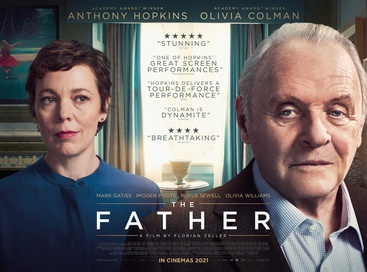
Last night I watched The Father, my most anticipated film since I saw the trailer, which in itself was a masterclass in both editing and film marketing. The performances saw Anthony Hopkins and Olivia Coleman nominated for Oscars at the 93rd Academy Awards.
Directed by Florian Zeller, The Father tells the story of a man suffering from the late stages of dementia and the effect it has on his family and himself. There are many films that have tackled the deeply upsetting subject of dementia. The Notebook, Still Alice, and The Iron Lady are critically acclaimed films that in one form or another try to tell the story of dementia, those who suffer from it and the effects it has on their loved ones.
However most of these films are told from a more objective perspective, the audience while they might be aware of what is happening and can sympathise with the characters, the story is told in such a way that is friendly to the narrative and the audience is able to grasp a clear picture of everything that is happening. It allows the audience to witness everything that the characters on screen are dealing with and demonstrate the difficulties associated with it.
The Father takes an approach that requires a lot more work from the audience. While the opening scene is narratively very standard. A daughter having a conversation with her father about his treatment of the carers. The next scene throws the audience into the deep end of narrative structure when Anthony walks out of his kitchen into a living room where sits a man he has never seen, not only is this man allegedly his single daughter’s husband but the flat he believed to be his belongs to his daughter.
The film’s narrative is not traditional. It instead tells the story from the perspective of a man who is in the late stages of dementia. Instead of objectively telling us the story, the audience must suffer through with him, they are confused like he is and they are unable to quite get to grips with the world around them. The editing techniques would find themselves at home in a much more arthouse film, at times resembling an Avant Garde thriller, unsettling and scaring the audience as Anthony is.
There are only brief moments of objectivity in the film where the perspective switches from Anthony to his daughter Anne, these scenes while showing the painful toll this is taking on her also serve to fill the audience in just enough to continue with the story, although never reveal too much so as to keep them in the perpetually confused state that Anthony is in.
The narrative doesn’t come together until the last scene in which the audience must watch Anthony at his lowest point, forgetting who he is and crying for his mother. It is a devastating piece of film that simultaneously broke a lot of people sitting in the cinema screen, who have spent the better part of 90 minutes experiencing his world first hand and must now leave the man that they not only watched but in many ways were part of.
This film might be one of the best films this year. It is an important film that everyone should see. The filmmakers also successfully stop the film at points from becoming too bleak and unwatchable by breaking the tension and sadness with moments of humour, love and humanity. The filmmakers have successfully made a sensitive and thoughtful piece of work that while fictional is very much a true story for most people at some point in their lives.
Resources:
https://www.nhs.uk/conditions/dementia/about/
https://www.alz.org/help-support/resources
https://www.dementiauk.org/
https://www.alzheimers.net/do-not-ask-me-to-remember-poem
 T H E N A I V E F I L M M A K E R