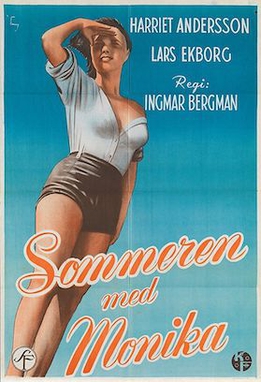
This one might stir controversy if more people read my blog, but I have an opinion that I can no longer hide. But I must also state for the record that Bergman is one of the best storytellers of our time! As I’ve written previously about how several of his films transcend traditional narrative and tell gripping stories about layered characters. Winter Light, Wild Strawberries and The Seventh Seal all do this flawlessly and often incorporate additional themes that dominated the public psyche during his lifetime and continue to do so (Probably why they’re so timeless).
But I never thought very much of Summer with Monika! Despite it being one of Bergman’s most famous films, I think it’s wrongly considered to be one that defines his style and body of work. It’s not a weak film as such. However it doesn’t measure up to his filmography and it surprises me that it often ranks so highly on top tens lists and critics favourite lists, when its competing against Bergman’s entire body of work.
I Actually Mostly Like It…
It was unique for its time, and along with other Swedish films like “One Summer of Happiness”. (Mattsson, 1951), played a role in the liberated branding that would dominate Sweden’s imagine on the world stage. It’s also beautifully shot with very good performances from Sundquist and Jacobsson.
The first half of the film is actually quite exceptional. Telling the story of two teenagers who aren’t enjoying life very much. Harry struggling with a job he gets no fulfilment from and Monika in an abusive, unhappy home. They take solace in each other and find hope in their mutual enamourment, ultimately leading them to abandon their lives and spend an “Idyllic” summer.
The film doesn’t take much time to demonstrate the idyllicness of the summer though, focusing more on the small conflicts that arise between the pair and their quick descent into desperation as they run out of money, food and supplies, an agitated attempt at stealing food and an unplanned pregnancy ultimately leads them back to civilisation and the audience hasn’t really had any time to take in the happiness that we’re told they experienced.
The Conclusion Lets it Down…
Summer with Monika could have ended at the conclusion of their summer, now scared to face the consequences of the difficulties they’re going to face back in the real world. However it continues on, becoming less Bergman and more Kitchen Sink drama. The film becomes dominated with the social message of “Uh oh, these kids have acted irresponsibly and are now facing life long consequences”. Focus returns to their working class situation and on Monika’s newly found hatred of being a wife and mother, which while a valid and interesting subject to explore, is mostly written off as “Nice Harry has gotten himself into trouble” and “Nasty Monika, caused all this trouble for Harry”.
The ending of Harry being left abandoned, homeless and with a child he can scarcely provide for is more similar to A Taste of Honey (Richardson, 1961) than it is a Bergman Project, and his seeming longing for Monika and a return to their barely covered happy time together doesn’t make much sense given all that she’s put him through.
For me personally, a film about a summer, shouldn’t go on much past the summer. Moonrise Kingdom (Anderson, 2012), Superbad (Mottola, 2007), and Kings of Summer (Vogt-Roberts, 2013) are all modern examples of coming of age films, focused on a small but significant time in the protagonists life.
Ultimately the film doesn’t really decide what it’s trying to do, as well as Bergman’s other films. Is it Coming of Age? Is it a Kitchen Sink? Ultimately the audience could have come to the same conclusions had the film ended much earlier and left their fate more ambiguous.
Still Important…
To be fair, my trashing of this movie isn’t really justified as it went on to become a much loved film that has played a significant role in changing the landscape of World Cinema. But I like Wild Strawberries better and that’s that!
 T H E N A I V E F I L M M A K E R